You’ve just found out number three is on the way, and while the excitement is real, so is the panic. You’re staring at the back seat of your perfectly good family car, mentally trying to cram another car seat into a space that already feels tight with two. The internet says “just buy a 7-seater,” your mother-in-law is suggesting the kids take turns, and you’re wondering whether it’s physically possible to fit three car seats across the back seat without trading in the car you’ve only just finished paying off.
It is possible. Thousands of UK families do it every day. But it takes planning, the right seats, and a bit of measuring before you buy anything. This guide walks you through exactly how to make it work — from measuring your car to choosing the narrowest seats on the market, picking the right combination for different ages, and avoiding the mistakes that leave parents red-faced in the Halfords car park.
Measure Your Back Seat First
Before you spend a penny, grab a tape measure. The single biggest reason three-across setups fail is that people buy seats without checking whether they’ll actually fit.
Here’s what to measure:
- Total bench width — measure the usable width of the rear seat at the narrowest point, usually at seat-cushion level. Don’t include the door cards or armrests
- Individual seat widths — if your car has three distinct seat positions, measure each one separately. The middle seat is often narrower
- Seatbelt buckle positions — note where the buckle stalks sit. Bulky car seats can block the centre buckle, making it impossible to secure the middle seat
- ISOFIX anchor points — check how many ISOFIX points you have and where they are. Most UK cars have two sets (outer seats only). Some newer models have three
A typical UK family hatchback — your Vauxhall Astra, Skoda Octavia, Ford Focus — offers roughly 130cm to 145cm of usable rear bench width. Divide that by three and you’re looking at about 43cm to 48cm per seat position. That’s tight when most child car seats are 44cm to 50cm wide.
Write these numbers down. You’ll need them when shopping.
Understanding UK Car Seat Law
Before diving into which seats to buy, a quick recap of the legal requirements. Under UK law (gov.uk):
- Children must use a child car seat until they’re 12 years old or 135cm tall, whichever comes first
- Every child needs their own seatbelt or approved restraint — no sharing, no sitting on a sibling’s lap, no matter how short the journey
- Both R44 and R129 (i-Size) standard seats are currently legal in the UK, though R44 is being phased out
- Rear-facing is mandatory until at least 15 months under i-Size rules, and recommended for as long as possible
- Fines for non-compliance start at £500 — and more importantly, an incorrectly fitted seat won’t protect your child in a crash
There’s no law against fitting three car seats side by side. It’s completely legal, provided each child is properly restrained in an approved seat. The challenge is entirely practical: finding seats narrow enough to fit, and making sure each one is securely installed.
One thing parents often miss: check your car’s owner manual. Some manufacturers specify the maximum number of child restraints for the rear bench. Exceeding that recommendation could complicate an insurance claim after an accident, even if every seat is correctly installed.
Why Width Is Everything
When you’re fitting three seats across, width is the measurement that matters most. Forget about the fancy recline angles and cup holders for a minute — if the seat is too wide, it doesn’t go in. Simple as that.
Car seat widths vary enormously:
- Narrow infant carriers (Group 0+) start from about 41cm — the Joie Juva is one of the slimmest at 41cm wide
- Spinning/rotating seats tend to be wider — the Joie i-Spin 360, popular as it is, measures 58cm across. That’s nearly 20cm wider than a basic carrier. Two of those and you’ve already used up most of your bench
- High-back boosters for older kids (roughly 4-12 years) range from about 40cm to 50cm. The Britax Discovery Plus 2 comes in at around 40cm, making it a strong three-across option
- Extended rear-facing seats vary hugely — some are compact at 44cm, while others push past 50cm
The widest part of the seat matters too. On infant carriers, that’s usually where the carry handle attaches. On seats for older children, it’s the head area where the side-impact protection wings sit. Those wings are there for good reason — they save lives in side collisions — but they’re also the part that clashes with the neighbouring seat.
If you’re choosing seats specifically for a three-across setup, you want everything under 44cm wide. That gives you enough room in most family cars, with a little breathing space for seatbelt buckles and your own sanity.

The Best Seat Combinations for Three Across
Fitting three identical seats is rarely the answer. Kids at different ages need different types of seats, and mixing seat types strategically is how most families make three across work.
Three Under Four: The Hardest Setup
If all three children are young enough to need full harnessed seats, this is the toughest scenario. You need three bulky, well-padded seats, and they’re all fighting for the same space.
Your best approach:
- Outer seats: Two narrow infant carriers or compact i-Size seats installed via ISOFIX — something like the Joie i-Snug 2 (43cm wide) or the Nuna PIPA urbn (42cm wide)
- Middle seat: A belt-installed seat to avoid ISOFIX conflicts. The Joie Steadi (44cm wide) works well here and installs with a seatbelt only
Avoid rotating seats entirely in this scenario. They’re brilliant individually, but at 50cm+ wide, one spinning seat eats up the space a neighbouring seat needs.
Mixed Ages: Baby, Toddler, and Older Child
This is the most common three-across setup, and the easiest to solve:
- One outer seat: Infant carrier for the baby — choose a narrow one like the Joie Juva (41cm) or Cybex Aton B2 (44cm)
- Other outer seat: Compact toddler seat for the middle child — the Britax Dualfix Plus (44cm) or Joie Steadi (44cm) are solid choices
- Middle or remaining outer seat: High-back booster for the eldest — the Britax Discovery Plus 2 (40cm) or Graco Assure (40cm) are narrow enough to share the bench
Put the narrowest seat in the middle position. That’s usually the booster, and it’s also the easiest to secure with just a seatbelt since it doesn’t need ISOFIX.
Two Older Kids and a Baby
If your eldest two are old enough for high-back boosters (roughly 100cm tall and over 15kg), this setup is simple:
- Two outer seats: Narrow high-back boosters like the Britax Discovery Plus 2 at 40cm each
- Middle seat: Infant carrier or i-Size seat for the baby
At 40cm + 40cm + 43cm, you’re looking at 123cm total. That fits comfortably in virtually any five-seat family car.
Navigating the ISOFIX Problem
Here’s where three-across setups get tricky. Most UK family cars only have two sets of ISOFIX anchor points, both on the outer seats. If all three of your car seats need ISOFIX, you’ve immediately got a problem. For a related angle, see our Best Baby Car Seats 2026 UK: Group 0+ Newborn Picks guide.
The workaround is simple: at least one seat needs to install using the car’s seatbelt instead of ISOFIX. That seat goes in the middle.
This is perfectly safe. ISOFIX was designed to reduce installation errors — it doesn’t make the seat itself safer in a crash. A correctly installed seatbelt-secured seat performs just as well. The key word there is “correctly” — follow the manufacturer’s instructions to the letter, pull the seatbelt tight until there’s no slack, and check for movement. The seat shouldn’t shift more than 2.5cm in any direction.
Some seats offer both installation methods, which gives you flexibility. The Joie Every Stage, for example, can use either ISOFIX or a seatbelt. You’d use ISOFIX on the outer positions and switch to seatbelt mode for the middle.
A few things to watch for:
- Check that the middle seatbelt is a three-point belt, not a lap-only belt. Lap belts can’t safely secure a car seat (and are increasingly rare in newer UK cars, but still found in some older models)
- Make sure neighbouring ISOFIX seats don’t block the middle buckle stalk. Install the outer seats first, then check you can still reach the centre buckle
- Some ISOFIX bases are wider than the seat itself. If you’re using a separate base for an infant carrier, check the base width, not just the carrier
If your car does have three ISOFIX points across the back — and a few do, including the Vauxhall Insignia Grand Sport, Citroën C4 Picasso, and Peugeot 308 SW — that obviously simplifies things enormously. But don’t assume yours does. Check the manual or look under the seat back for the anchor symbols.
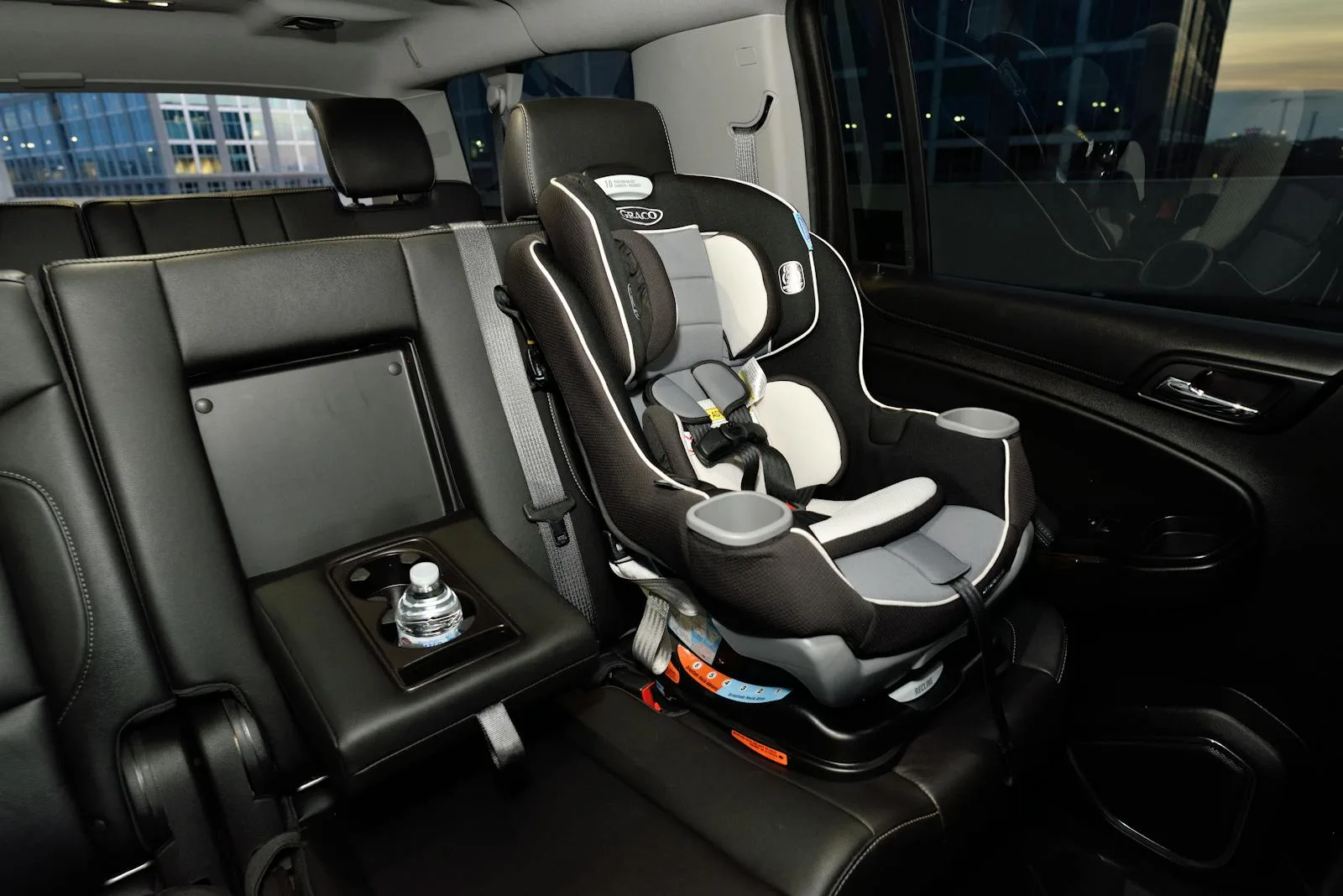
Step-by-Step Installation Guide
Getting three seats in is a process. Rushing it leads to the kind of frustrated YouTube search at 10pm that nobody wants. Here’s the order that works:
Step 1: Install the middle seat first. Whether it’s seatbelt-secured or ISOFIX (if you have a centre ISOFIX point), get this one locked down first. It’s the hardest to access, so doing it while you’ve got room to manoeuvre makes life noticeably easier.
Step 2: Install the outer seats. Clip in the ISOFIX connectors or thread the seatbelts through. Push each seat firmly into the vehicle seat to get a snug fit.
Step 3: Check for interference. With all three installed, try to wobble each seat. None should move more than 2.5cm side to side or front to back. Check that no seat is pushing against or leaning on its neighbour — they need to stand independently.
Step 4: Test the buckles. Can you still reach and fasten every seatbelt buckle? Can you clip and unclip the harness on each child seat? If you need a engineering degree to get a buckle done up, something needs to shift. Our Best Portable Car Seats for Travel and Taxis guide is useful alongside this.
Step 5: Do a child test run. Put the kids in. Strap them in properly. Drive around the block. Check comfort, check that nobody’s elbowing their sibling in the face, and check that you can get each child in and out without dislocating your shoulder.
If something doesn’t fit, don’t force it. A seat that’s wedged in under pressure isn’t properly installed, and it won’t perform in a crash the way it’s supposed to. Go back to the drawing board and try a different combination or a narrower seat.
Cars That Make Three Across Easier
Not all cars are created equal when it comes to fitting three across. Some make it relatively painless; others make it nearly impossible regardless of which seats you choose.
Cars with wider rear benches and three full-size seat positions give you the best chance. Popular UK family cars that work well include:
- Skoda Superb — one of the widest rear benches in its class, around 148cm. Three across is genuinely comfortable here
- Citroën C4 Picasso / C4 SpaceTourer — designed with family flexibility in mind, with three ISOFIX points and a flat rear floor
- Ford Mondeo — generous rear width and accessible seatbelt buckles
- Land Rover Discovery — plenty of width, though the Discovery is a bigger (and pricier) proposition
- Volkswagen Touran — practical layout with good access to the middle seat
- Kia Sportage — newer models have a decently wide bench for a compact SUV
Cars that tend to struggle:
- Ford Fiesta / Vauxhall Corsa — the rear bench is simply too narrow for three child seats
- Most three-door cars — even if the width is there, getting three children in and out through a single door is a daily ordeal
- Cars with a pronounced centre tunnel — a high transmission tunnel reduces usable space in the middle position
If you’re buying a new car with three-across in mind, take your seats to the dealership for a test fit before you sign anything. Manufacturers’ quoted measurements don’t always tell the whole story — seat cushion shape, buckle placement, and ISOFIX position all affect whether it works in practice.
Common Mistakes to Avoid
After years of parents wrestling with this exact problem, the same mistakes come up again and again:
- Buying seats without measuring first — this is number one. “It looked narrow online” doesn’t cut it. Measure your car. Check the seat dimensions. Do the maths before you hand over your card
- Forgetting about the carry handle — infant carriers look compact from the front, but the carry handle adds width. When the handle is upright (which it must be during travel in many models), it can clash with the neighbouring seat’s headrest
- Ignoring the middle seatbelt type — if your car has a lap-only belt in the middle, you cannot safely install a car seat there. Full stop
- Choosing style over function — that gorgeous spinning seat with the premium fabric? It might be 55cm wide. For three across, function wins every time
- Not checking both the seat AND the base — ISOFIX bases can be wider than the seats that sit on them, especially with infant carriers
- Installing in the wrong order — always do the middle seat first. Trying to wedge a seat into the centre position after the outer two are already in is a recipe for scratched trim and strong language
When Three Across Just Won’t Work
Sometimes, despite your best efforts, three across isn’t happening. Your car might be too narrow, the seat combination might not play nicely together, or the middle seatbelt might be inaccessible with seats either side.
You’ve got options:
- Multi-seat systems — products like the Multimac replace the entire rear bench with a purpose-built child seat unit that holds three or four children. They’re not cheap (from about £1,700), but they solve the problem completely and work in most five-seat cars. Worth considering if you’ll need three seats for several years
- 7-seater vehicles — spreading children across two rows eliminates the width problem. Cars like the Citroën Berlingo, Volkswagen Touran, or Ford Galaxy give you flexibility, though running costs and parking headaches come with the territory
- Front passenger seat — in some circumstances, you can legally put a child seat in the front, provided the airbag is deactivated. Check your car manual and the seat manufacturer’s guidance. It’s a last resort, not a long-term solution
For most families, though, three across is achievable with the right combination of car seats. It just takes a bit more homework than buying two.
Keeping Everyone Comfortable on Longer Journeys
Fitting three seats in is one thing. Keeping three children happy on a two-hour drive to the grandparents’ is another challenge entirely.
A few things that help:
- Padding matters — cheaper narrow seats sometimes sacrifice padding for slimness. If your kids will be spending serious time in these seats, check the cushioning. Removable washable covers are a bonus when someone inevitably spills their juice box
- Headrest height adjustment — make sure every seat can grow with your child. Adjusting the headrest should be possible without removing the seat from the car
- Airflow — three children generate a surprising amount of heat. If your car has rear air vents, make sure no seat is blocking them. Open windows on both sides to create cross-ventilation
- Reach — can your kids reach their own drinks and snacks? If the seats are packed tightly, there’s less room for the accessories parents rely on during long trips. Consider an organiser that hangs from the front headrests instead
Understanding how car seat safety ratings work will help you make informed trade-offs between size, comfort, and protection.
Checking Your Seats Are Still Safe
While you’re reorganising the back seat, it’s a good time to check each seat is still in good condition. Car seats have expiry dates — typically six to ten years from the manufacture date — and the plastics and foam degrade over time, especially with exposure to heat and UV light.
Check the label on each seat for the manufacture date, and make sure none of your car seats are expired or recalled. A seat that’s been in a collision should be replaced immediately, even if there’s no visible damage. The internal structure may be compromised in ways you can’t see.
Frequently Asked Questions
Can you legally fit three car seats across the back seat in the UK? Yes, it is completely legal to fit three car seats across the back seat in the UK, provided each child is properly restrained in an approved car seat that meets either R44 or R129 (i-Size) standards. There is no law limiting the number of child seats in a row.
How wide does my back seat need to be for three car seats? You typically need at least 125cm to 130cm of usable bench width for three narrow car seats. Most UK family hatchbacks offer 130cm to 145cm. Measure your car's rear bench at seat-cushion level before buying any seats.
Do I need three ISOFIX points to fit three car seats? No. Most cars only have two ISOFIX points on the outer seats. You can install the middle seat using the car's three-point seatbelt instead. A correctly installed seatbelt-secured seat is just as safe as an ISOFIX-installed one.
What are the narrowest car seats available in the UK? Some of the narrowest car seats available in the UK include the Joie Juva infant carrier (41cm), Britax Discovery Plus 2 high-back booster (40cm), Graco Assure booster (40cm), and the Nuna PIPA urbn (42cm). Look for seats under 44cm wide for three-across setups.
Which seat should I install first when fitting three across? Always install the middle seat first. It is the hardest position to access, and fitting it while you have room to manoeuvre on both sides makes installation much easier. Then install the two outer seats and check that all buckles remain accessible.