A cabin-approved pushchair only earns the name if it folds small enough, locks shut, and can survive the awkward bit at the aircraft door when staff decide whether it goes overhead or into the hold. The safest way to shop is to treat “cabin approved” as a claim to verify, not a promise.
In This Article
- Cabin-Approved Pushchair Claims Need a Reality Check
- The Folded Size That Actually Matters
- The Pushchairs Most Likely to Fit Overhead Lockers
- Airline Rules: What Usually Happens at the Gate
- What to Check Before You Buy
- Airport Use: Getting Through Security, Boarding and Arrival
- My Verdict: Which Cabin-Approved Pushchair Would I Buy?
- Frequently Asked Questions
Cabin-Approved Pushchair Claims Need a Reality Check
The phrase cabin-approved pushchair sounds reassuring, but it is not a universal airline standard. It usually means the stroller folds near common cabin-bag dimensions and is compact enough to be considered at the gate. That is different from a guaranteed right to put it in the overhead locker.
Cabin approved is not airline approved
Manufacturers want a simple badge. Airlines work with aircraft type, fare rules, cabin crew judgement, bin space and how full the flight is. A pushchair can be small enough on paper and still be gate-checked if the overhead lockers are full.
That matters because parents often buy a travel stroller for one specific pain point: avoiding the wait at oversized baggage while carrying a tired toddler. A cabin approved pushchair fold overhead locker claim is useful, but only if the folded dimensions, airline rules and real boarding process line up.
If you want the wider travel process, read our guide to flying with a pushchair. Here, the job is narrower: which compact pushchairs are most likely to fold small enough for overhead lockers, and what trade-offs you accept to get that tiny fold.
The trade-off nobody mentions enough
The smaller the fold, the more you usually compromise somewhere else. The seat may be narrower. The basket may be tiny. The wheels may rattle over cobbles. The recline may be fine for a toddler nap but poor for a newborn. That does not make compact strollers bad; it just means they are specialist tools.
For everyday UK use, a bigger pushchair may be nicer. Our Best Pushchairs 2026 guide covers more rounded options. For airports, trains, taxis and short city breaks, compact-fold strollers earn their keep.
The Folded Size That Actually Matters
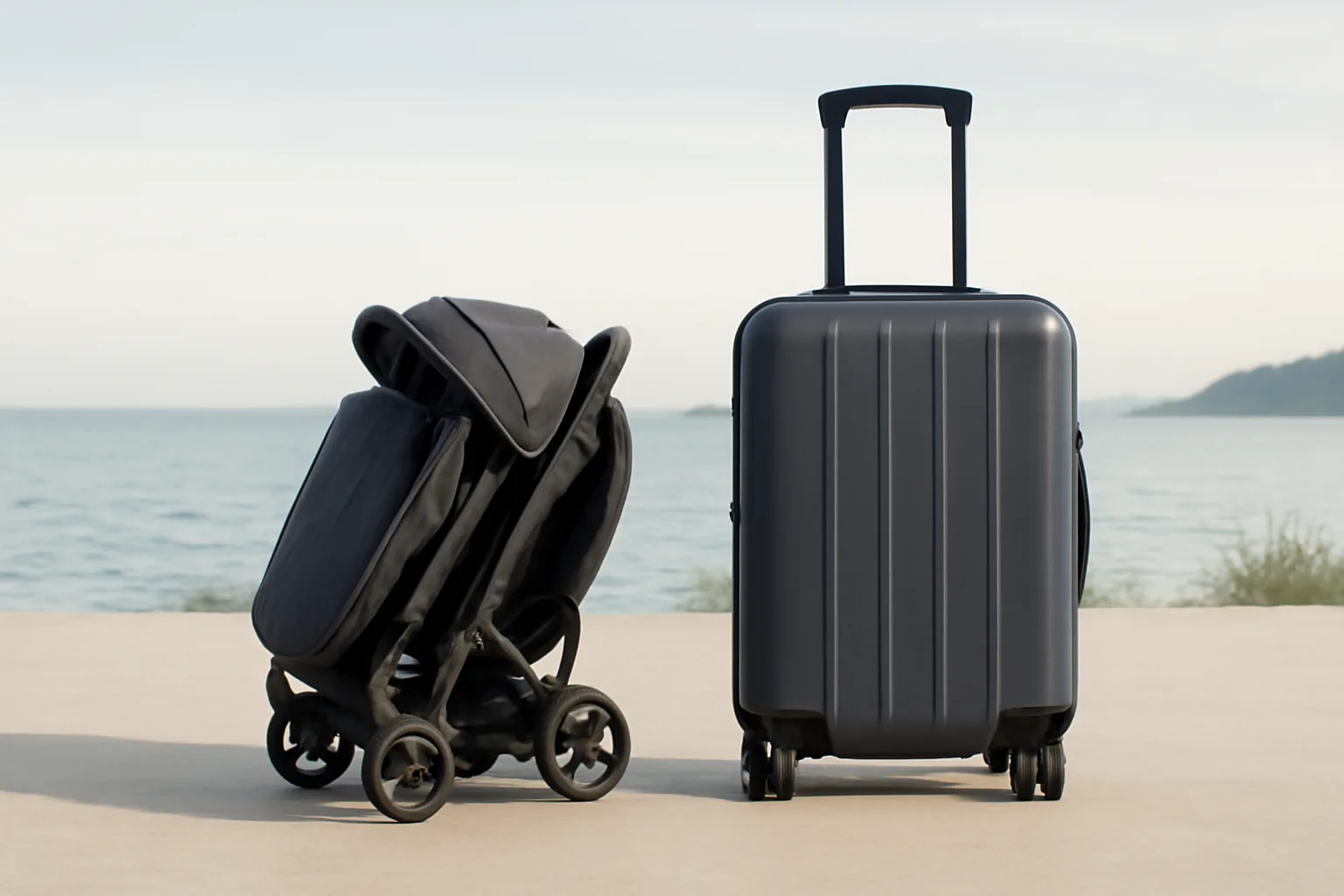
There is no single magic measurement, but 55 x 45 x 25cm is the number many parents use as a rough overhead-locker target because it sits near common cabin-bag limits. Smaller is better. A stroller that folds to around 52 x 44 x 18cm has a much stronger case than one claiming travel status at 60 x 45 x 25cm.
Compare the folded size, not the marketing name
When comparing models, look for:
- Folded height: ideally under 55cm, including wheels and handle.
- Folded width: ideally under 45cm, because width is where some compact strollers fail.
- Folded depth: under 25cm is useful; under 20cm is excellent.
- Weight: around 6-7.5kg is realistic for a proper travel pushchair.
- Fold lock: it should stay shut when you lift it, not unfold like a deckchair at the gate.
Do not trust a photo of a stroller beside a suitcase. Find the dimensions in centimetres. Then check whether the measurement includes wheels, bumper bar and any carry bag. Some brands quote the neatest possible fold with accessories removed.
Overhead locker fit also depends on shape
Two pushchairs can have similar dimensions but behave differently. A rectangular folded shape slides into bins more easily than an awkward long package with protruding wheels. A soft travel bag can help stop scuffs, but it can also add bulk and make the stroller harder to identify quickly.
If you fly often, measure your folded stroller at home with a tape measure and write the numbers in your phone. It sounds fussy until a gate agent asks, and then you look like the only organised person in the queue.
The Pushchairs Most Likely to Fit Overhead Lockers
No stroller is guaranteed on every airline, but these are the UK models I would shortlist first if overhead-locker fit is the priority.
Babyzen YOYO2 / Stokke YOYO3: safest cabin bet
The YOYO is the benchmark for this category. The YOYO2 typically costs about £399-£449 for the 6+ stroller, with newborn packs and colour packs adding more. The newer Stokke YOYO3 sits around £430-£480 depending on bundle.
The folded size is roughly 52 x 44 x 18cm, which is why so many travelling parents copy it. It folds small, carries over the shoulder, and staff recognise it. That recognition is worth something at airports.
The downsides: the basket is modest, the ride is not plush, and the total price climbs quickly once you add newborn kit, rain cover, cup holder or board. For frequent flying, though, it is still the one I would trust most.
Joolz Aer+: best comfort-to-fold balance
The Joolz Aer+ is usually around £399-£429 from John Lewis, Mamas & Papas, Natural Baby Shower and other UK retailers. It folds to about 53.5 x 45 x 21.5cm and weighs roughly 6kg.
The seat feels more generous than many tiny travel strollers, the shoulder strap is useful, and the fold is quick once you know the movement. I like it for parents who want one travel stroller that can also handle nursery runs and pavements without feeling too flimsy.
It is slightly bulkier than the YOYO, so I would be more cautious on stricter airlines. Still, as a balance of comfort, weight and fold, it is one of the strongest options.
Bugaboo Butterfly: lovely stroller, less certain overhead fit
The Bugaboo Butterfly costs about £419-£459 in the UK. It folds to roughly 54 x 45 x 23cm and weighs about 7.3kg. It is beautifully practical: good seat, good basket, fast fold, and better everyday feel than the smallest travel strollers.
The issue is that its depth is closer to the limit. It may fit overhead on many flights, but it is not as reassuring as the YOYO if you are dealing with a strict low-cost carrier or a packed short-haul flight.
If you want a compact stroller for daily life first and flights second, the Butterfly makes sense. If you are buying mainly to win the overhead-locker battle, I would lean smaller.
Silver Cross Jet: strong UK travel option
The Silver Cross Jet range is usually around £345-£395, often discounted at John Lewis, Boots, Direct4Baby and Natural Baby Shower. It is designed around travel and has a pull-along suitcase-style fold.
The folded package is compact enough to be in the conversation, though you should check the exact Jet version because dimensions vary by model year. The pull-along feature is useful in airports, especially if you are also carrying a changing bag and a car seat.
The ride is better than ultra-basic travel strollers, but I would still test the fold in person. Silver Cross often feels polished, but the best travel pushchair is the one you can fold calmly while holding a boarding pass, a snack and one half-removed shoe.
Cybex Libelle: smallest fold, more compromise
The Cybex Libelle is often £219-£269 in the UK and folds very small, around 32 x 20 x 48cm depending on version. It is one of the easiest to justify for overhead lockers because the fold is tiny.
The compromise is everyday comfort. The wheels are small, the seat is basic, and it is not the pushchair I would choose for long naps or rough paths. For city breaks, older toddlers and carry-on-first travel, it is clever. For a baby who sleeps in the stroller every afternoon, I would think twice.
Budget options under £200
The Joie Tourist, Graco Myavo and similar budget travel strollers often sit around £130-£190. They can be excellent value if you accept that overhead fit may be less certain and the finish will not match Bugaboo, Joolz or YOYO.
If your budget is tight, start with our pushchair buying on a budget guide, then check the folded dimensions of any travel model you shortlist. Under £200, I would prioritise a reliable fold lock, decent harness and usable rain cover over fancy fabric.
Airline Rules: What Usually Happens at the Gate
Airlines do not all treat compact pushchairs the same way. Some staff will allow a folded stroller as your cabin bag if it meets the size rules. Others will tag it at the gate as baby equipment, especially if the flight is full.
Check the cabin-bag rule for your fare
GOV.UK’s hand luggage restrictions guidance gives the boring but correct advice: check with your airline how many bags you can take and what size they can be. That matters for pushchairs because the same folded stroller may be treated differently depending on the airline, route, fare and aircraft.
easyJet’s free small cabin bag is 45 x 36 x 20cm and must fit under the seat in front, according to its cabin bags guidance. Larger overhead cabin bags are tied to fare, seat or paid allowance. That makes many compact strollers too large for the free under-seat allowance, even if they are small enough for an overhead locker.
Ryanair, Wizz Air, Jet2, TUI and Virgin Atlantic all have their own rules. Do not rely on a forum screenshot from three years ago. Check your actual airline and fare the week you fly.
The gate decision still matters
Even if the dimensions work, the gate crew may ask you to leave the stroller at the aircraft door. That is more likely on full flights, smaller aircraft, late boarding groups and low-cost routes where overhead space is under pressure.
This is why I would never pack passports, medication, headphones or a child’s favourite toy inside the stroller bag. If the pushchair gets tagged for the hold, anything inside it may disappear until baggage reclaim.
Carry bag or no carry bag?
A carry bag keeps the stroller cleaner and makes it look more like cabin luggage. It also slows you down and can add bulk. For the YOYO, the shoulder strap and compact fold are often enough. For the Silver Cross Jet, the pull-along style is part of the appeal. For the Bugaboo Butterfly, a bag is useful if you are worried about scuffs.
Expect branded travel bags to cost £35-£80. Generic stroller bags cost about £15-£30 on Amazon UK, but they are often loose and oversized, which can work against the cabin-size argument.
What to Check Before You Buy
The best cabin stroller is not automatically the smallest one. It is the one small enough for your airline habits and usable enough for your child.
Age and newborn suitability
Some compact pushchairs are suitable from birth with a lie-flat recline or newborn pack. Others are better from around six months when your baby has stronger head and trunk control.
If you have a newborn, check the seat angle, head support and whether the newborn setup changes the folded size. A stroller that is cabin-sized in toddler mode may become less convenient with a bassinet-style attachment.
For car-seat travel, our guide to using a car seat on an aeroplane covers the separate rules and practicalities.
Weight and one-hand carry
Six kilograms sounds light until you are carrying it down aircraft steps with a backpack and a toddler who has decided legs are over. Try the carry strap in a shop. Lift it above shoulder height. If you cannot comfortably lift it into an overhead locker at home, do not expect airport adrenaline to fix that.
The YOYO and Aer+ are good here. The Butterfly is still manageable but noticeably more substantial. Ultra-compact models like the Libelle are easier to carry but give up comfort.
Seat comfort, shade and basket space
Tiny strollers often have tiny baskets. That is fine for passports, wipes and a water bottle, less fine for a full changing bag. Check the basket opening, not just the claimed capacity.
Shade matters too. A short hood is annoying on bright airport transfers and summer city breaks. A rain cover is worth having in the UK even if your main use is holidays, because the journey to the airport car park will usually choose violence.
Accessories can help, but they add cost. A rain cover may be included or cost £25-£45. A bumper bar can be £25-£40. A travel bag can be £35-£80. A footmuff may be £70-£130. Our pushchair accessories guide explains which extras are worth paying for.
Wheels and real pavements
If your trips are mainly airports, hotels and smooth city streets, small wheels are fine. If you want one stroller for UK parks, gravel paths and beach promenades, a cabin stroller may frustrate you.
For rougher everyday use, look at all-terrain pushchairs. They will not fold into an overhead locker, but they are far better on mud, grass and broken pavements.
Airport Use: Getting Through Security, Boarding and Arrival
A compact-fold pushchair is only helpful if you use it deliberately. The airport is where neat product demos meet real parenting.
Before security
Empty the basket before you reach the trays. Fold the pushchair only when asked, but be ready. If the stroller needs two hands and a knee to fold, practise at home until you can do it without muttering.
Keep a sling or carrier in your cabin bag if your child is small. It saves you when the pushchair has to go through the scanner, gets gate-checked, or is returned at baggage reclaim rather than the aircraft door.
Boarding
Boarding early is useful, but not for the reason people think. It gives you time to fold the stroller calmly and find overhead space before everyone else fills it with hard cases. If you board last, even a tiny stroller may be tagged because the bins are full.
If staff ask to gate-check it, stay polite and ask where it will be returned. Aircraft door return is ideal. Baggage reclaim is less helpful, especially at a big airport after a late flight.
Arrival
Pack assuming you might not get the pushchair back until baggage reclaim. Keep snacks, nappies, wipes and medication in your cabin bag, not in the stroller basket. If your child is still small enough for a carrier, bring one.
After the trip, give the stroller a quick clean before storing it. Airport floors, rain, sand and snack dust are not kind. Our guide to cleaning and maintaining your pushchair covers the sensible routine.
My Verdict: Which Cabin-Approved Pushchair Would I Buy?
If overhead-locker fit is the main goal, I would buy the YOYO. It is expensive, but it has the best mix of compact fold, airport recognition, resale value and real-world parent confidence. Budget about £400-£480 depending on version and bundle.
If I wanted a nicer everyday stroller that still has a good overhead chance, I would buy the Joolz Aer+. It feels less like a compromise and still folds small enough for many trips. Budget about £399-£429.
If I wanted the smallest possible fold for an older toddler and short trips, I would look at the Cybex Libelle. It is not as comfortable, but at roughly £219-£269 it makes sense as a second travel stroller.
The Bugaboo Butterfly is the one I like most as an everyday compact pushchair, but I would not buy it purely for the overhead-locker promise. It is too close to the edge on some airline limits. The Silver Cross Jet is a strong UK travel pick if you like the pull-along fold and find a good discount.
The blunt answer: for frequent flights, buy the smallest proven fold you can live with. For one holiday a year, you may be better gate-checking your normal pushchair and spending the money on a decent travel bag, a carrier and snacks with bribery-level power.
Frequently Asked Questions
What size pushchair fits in an overhead locker? There is no universal size, but around 55 x 45 x 25cm or smaller is the practical target many parents use. Always check your airline and fare before flying.
Is the Babyzen YOYO allowed as cabin baggage? It is one of the most widely accepted compact strollers because it folds to roughly 52 x 44 x 18cm, but airline staff can still gate-check it if overhead space is full.
Can I take a pushchair on easyJet as cabin luggage? easyJet’s free under-seat cabin bag size is smaller than many compact strollers. A pushchair may need to count as a paid overhead cabin bag or be taken at the gate, depending on your fare and flight.
Is a cabin-approved pushchair suitable from birth? Some are, but only with a lie-flat seat or newborn pack. Check whether the newborn setup changes the fold, weight or cabin-size claim.
Should I buy a travel bag for a cabin pushchair? A bag protects the stroller and can make it look more like luggage, but it may add bulk. For very compact models, the built-in strap may be enough.
Which cabin pushchair is best for everyday use? The Joolz Aer+ and Bugaboo Butterfly feel stronger for daily use than the smallest ultra-compact strollers. The YOYO is still the safest frequent-flyer choice.